Sunday, April 14, 2019

Universal Basic Income pilot results from Finland and India

India Sikkim state landscape 
In a previous post, I was introducing the Basic Income concept together with few operating and announced pilots. I was also questioning whether we can find a link between the Basic Income and the United Nations Sustainable Development Goals.

One of the possible link is the 'new' transient nature of poverty. Because of the increased global and local climate risks. Several studies of economists prove that poverty is transient in nature, i.e., individuals move in and out of poverty (Dercon and Shapiro 2007).
Therefore, the idea of a Basic Income is interesting to get the poor from their poverty and, given the transient nature of poverty, a Basic Income could provide insurance against economic shocks in many poorer countries. Policymakers should take into account the transient nature of poverty with including a much larger share of the population.

Finland pilot: self-perceived well-being improved, during the first year, no effects on employment. 

In the same previous post, I presented two pilots: the Kenya pilot with preliminary results that GiveDirectly, a New York-based nonprofit has initiated in a rural village in Western Kenya, in October 2016, and the pilot launch in Finland. Just a a reminder, in January 2017, 2000 Finnish unemployed people received their first cash transfer of 560 euros, which they will continue to receive each month, until 31 December 2018. They were randomly selected from 25 to 58 years to participate in a study to assess the impact of universal basic income. During the evaluation of the basic income experiment they study the effects of the basic income on the employment status, income and well-being of the participants. The results are preliminary, and it is not yet possible to draw any firm conclusions regarding the effects of the basic income experiment.

Preliminary results of the Finland pilot: the recipients of a basic income perceived their well-being as being better than did the control group. 55% of the recipients of a basic income and 46% of the control group perceived their state of health as good or very good. 17% of the recipients of a basic income and 25% of the control group experienced quite a high degree or a very high degree of stress.
The recipients of a basic income had less stress symptoms as well as less difficulties to concentrate and less health problems than the control group. They were also more confident in their future and in their ability to influence societal issues’, says a lead researcher at Kela.

India Sikkim state is on the verge of becoming the first place on Earth implementing a basic income
Sikkim, the second smallest state in India, has grown a reputation, over the years, for environmental consciousness, ethnical diversity and tourism. It is also the home of one of the most educated people on Earth, with a 98% literacy rate. 
The Sikkim Democratic Front (SDF), the democratically elected party governing the state since 1994, has written basic income into its manifesto for the 2019 Assembly elections, and aims to have it implemented by 2022.This initiative is not intended as a pilot test, but as an actual implementation.
As for financing the basic income scheme, SDF officials are considering surplus energy generation revenue (from hydropower) and redirecting costs from welfare programs which cease to be relevant.

Germany 
A  pilot is being prepared in Germany in 2019

Interesting projects to follow... 

Sources
Kela, the Social Insurance Institution of Finland, is a government agency that provides basic economic security for everyone living in Finland. 


Friday, November 30, 2018

Are electric vehicles really good for the planet?

Monday, September 24, 2018

Prevent spread of epidemics in the world, using ICT


Source: Report's proposed governance model led by international organizations
The UnitedNations Sustainable Development Goals (SDGs) will shape the world agenda for at least the next 12 years. Governments, private sector, and the civil society adopted the 17 global goals to ensure prosperity for all as part of a new sustainable development agenda.

The idea that suggests that businesses are here to create value for their shareholders only, at the expense of the society, is gradually becoming obsolete. This tremendous awareness created by the agenda mentioned above is setting a trend and is forcing strategists to look at their market with both eyes. 
Because of this “Mobility Age” we’re in, no other industry than ICT is better positioned to enable the achievement of the global goals.

Representing Ericsson group, I had the opportunity to join an international cross-functional team of experts in the Working Group on Epidemic Preparedness-Preventing the Spread of Epidemics using ICT, which was established by the Broadband Commission for Sustainable Development. The work group was chaired and coordinated by Korea Telecom group. The objective of this international effort was to develop a proposal that addresses the challenge of preventing the spread of epidemics in the world using ICT and present it at the UN general assembly meeting in September 2018 in New York.

This report  has been developed through an iterative and collaborative process drawing on expertise from the members of the Broadband Commission Working Group. The coordination of experts and the development of the content were provided under the supervision of Korea Telecom group. In addition, critical contributions were made by work group members from the World Bank Group, the Pan American Health Organization (PAHO), the International Telecommunication Union (ITU), GSMA, Ericsson, health experts and scientists. The Working Group met online or offline on a quarterly basis, reviewed material, exchanged insightful ideas and discussed the strategic trajectory of the report.

Infectious diseases and epidemics outbreak have followed the history of human beings for ages, from the “Plague of Athens”, the first recorded infectious disease outbreak to modern times epidemics such as Ebola and MERS. Growing international exchanges, increase in population and urbanization, intensification of global climate and environmental changes, and inadequate systems of disease prevention and control are the leading causes of severe epidemics in modern society. An epidemic outbreak could cause the loss of many lives and have a devastating economic impact estimated of 60 billion US dollars loss per year.

Mobile industry
Mobile technology has experienced a rapid technical development, increasing network coverage, and an exponential increase of cell phones user rates all over the world. According to Q2/2018 Ericsson MobilityReport, there are around 5.5 billion subscribers globally.
Mobile networks have brought voice and internet services to billions of people around over the last 25 years. At the current trajectory, mobile broadband will provide network coverage to around 95% of the world’s population by 2022.

Mobile industry has a great potential to deliver life-saving information even in the most remote and resource poor areas. Additionally, it offers an effective contribution to public health initiatives in support of achieving the health outcomes related to the Sustainable Development Goals (SDGs) while being economical, effective, and sustainable.

Big data availability

The explosion of data from different sources; mobile network, IT services is a great opportunity to address this challenge. Different type of data could be used in the fight against epidemics for analytics and/or simulation: genetic data, mobile network’s Call Data record (CDR), roaming data, Cell phone mobility, Social media data, Location-based information data, and you name it.
Various technologies exist to collect, analyze, and report various epidemics-related data. Using different sources of data is important to create an accurate view of the epidemic situation. The simultaneous collection of CDRs, roaming data, IoT data, location-based data and social media data will provide the Analytics platforms with enough information to produce accurate reports, that could help governments and organizations to take the right decisions.

The report proposes three important recommendations:

  1. Regulation for Safe Personal Data Utilization: Currently, many countries around the globe have privacy protection laws in place. However, this should not lead to the loss of opportunities to prevent the spread of epidemics in an early manner.
  2. Establishment of epidemics data sharing/monitoring system: Data sharing and utilization among nations around the world is essential to effectively fight epidemics.
  3. Expansion of global governance: There is a need for global governance to be jointly led by international organizations of various fields, such as UN, ITU, and WHO. international organizations can include the establishment of epidemics-related regulations and policy guidelines that governments around the world can refer to and the promotion of the private-public-international community participation to build an integrated system.

You are encouraged to comment, suggest and keep the dialog vivid on this important topic that will positively impact us all.

Note: this blog has been published simultaneously in the Ericsson Technology for good blog

Friday, April 20, 2018

What experts say...

Joseph E. Stiglitz, a Nobel laureate in economics, is University Professor at Columbia University and Chief Economist at the Roosevelt Institute.
Read what he has to say about trade war, technological leadership, AI, 5G:

"Today’s trade conflict reveals the extent to which America has lost its dominant global position. When a poor, developing China started increasing its trade with the West a quarter-century ago, few imagined that it would now be the world’s industrial giant. China has already surpassed the US in manufacturing output, savings, trade, and even GDP when measured in terms of purchasing power parity.

Even more frightening to many in the advanced countries is the real possibility that, beyond catching up rapidly in its technological competence, China could actually lead in one of the key industries of the future: Artificial Intelligence. AI is based on big data, and the availability of data is fundamentally a political matter that implicates issues such as privacy, transparency, security, and the rules that frame economic competition.

The EU, for its part, seems highly concerned with protecting data privacy, whereas China does not. Unfortunately, that could give China a large advantage in developing AI.

And advantages in AI will extend well beyond the technology sector, potentially to almost every sector of the economy. Clearly, there needs to be a global agreement to set standards for developing and deploying AI and related technologies. Europeans should not have to compromise their genuinely held concerns about privacy just to promote trade, which is simply a means (sometimes) to achieving higher living standards.

In the years ahead, we are going to have to figure out how to create a “fair” global trading regime among countries with fundamentally different economic systems, histories, cultures, and societal preferences."


Source:
- https://www.project-syndicate.org/commentary/trump-unnecessary-trade-war-by-joseph-e--stiglitz-2018-04

Thursday, April 12, 2018

Will 5G unleash a "digital" cold war ?


5G logo
We are in an era where apps, artificial intelligence and connected objects are entering, disrupting and revolutionizing sectors as diverse as transport, energy, health, finance or construction. Mastering mobile networks technology is becoming crucial.
It is not involving the telecom industry alone, but all industries are impacted.

This is why China has made 5G one of its economic and strategic priorities. 5G is one of the pillars of  Made in China 2025 plan (plan that I wrote about recently, you can click on the link to go to the corresponding post). It aims to make China a world reference in terms of innovation and new technologies, while it has long been seen as a low-cost country simply copying more or less foreign products. For China, 5G is part of the essential technological foundations that will allow the emergence of economic champions. The goal is to be the first to deploy 5G technology throughout its territory, while being a leader in the field of patents, standards, design and manufacturing of these high-speed networks; knowing that 5G technology is designed to connect objects from different industries.

Higher investment
China has worked hard in the 5G. According to a forecast  from the Ministry of Industry and Information Technology, China's cumulative investment in 5G will reach by 2025, 214 billion US dollars!   

Of course, Chinese telecom equipment manufacturers are among the main beneficiaries. 

For the United States, China's ambitions in 5G pose a serious threat to the US economy.
The 5G race is not just a technological battle!! Both China and USA believe that the one who wins will have a decisive advantage to take the world economic leadership in the longer term.  

So if China is heavily investing in this technology -which is, by the way, totally legitimate and fair-, what are the other developed countries doing? What are the plans from Europe, Japan, USA?

We haven't heard of any concrete, elaborated plan, rather than few "shy" & unclear initiatives here and there.

Or is the only response is a "digital" cold war; a trade war by taxing products ??

Saturday, April 7, 2018

What is the "Made in China 2025" plan ?


 China, which has already surpassed Japan as Asia's leading exporter of high-tech products in 2014, is now looking to take the lead from the United States and Germany; With competitive multi-national companies in high value-added products.

The Made in China 2025 plan draws direct inspiration from Germany's "Industry 4.0" plan and is designed to elevate China from "world factory" to "big industrial power", mastering research, innovation and high value-added production.


This "Made in China 2025" redefines all of China's industrial priorities. China wants to be at the forefront of the new industrial revolution linked to digital integration. As the efficiency and quality of Chinese producers are highly uneven, and multiple challenges need to be overcome in a short amount of time, China wants to avoid being squeezed by newly emerging low-cost producers and wants more effectively to cooperate and to compete with advanced industrialized economies.

The Made in China 2025 has clear goals, tools, and sector focus. Its guiding principles are to have manufacturing be innovation-driven, emphasize quality over quantity, achieve green development, optimize the structure of Chinese industry, and nurture human talent.
    The plan highlights 10 priority sectors:
    1. New advanced information technology;
    2. Automated machine tools & robotics;
    3. Aerospace and aeronautical equipment;
    4. Maritime equipment and high-tech shipping;
    5. Modern rail transport equipment; 
    6. New-energy vehicles and equipment; 
    7. Power equipment; 
    8. Agricultural equipment; 
    9. New materials; 
    10. Biopharma and advanced medical products.
      It focuses on the entire manufacturing process and not just innovation.The plan also specifies focus on the countries that together make up the Silk Road initiative.

      Multi-national companies will most probably face new challenges with this plan.
      A clear goal is to make Chinese companies more competitive across the board, to localize production of components and final products, and to have Chinese firms move up the value-added chain in production and innovation networks, and to achieve much greater international brand recognition.

      So is there an impact on the world economy? Are there opportunities in this plan for non-Chinese multi-national companies?

      post to be continued...


      Sources:
      • http://english.gov.cn/2016special/madeinchina2025/
      • https://www.csis.org/analysis/made-china-2025
      • https://www.theguardian.com/world/
      • https://www.lesechos.fr/idees-debats/editos-analyses/

      Friday, October 6, 2017

      is a Universal Basic Income a good solution to end Poverty?


      Recently, the Universal Basic Income (UBI) has hit the news headlines around the world;either because few politicians included it in their political programs (France, Finland, India) or a number of influential people said that they support the idea (Tesla's Musk, Facebook's Zuckerberg or Virgin's Branson, Bill Gates to name a few).  This has not left the economists aside, instead many economists from different economics schools delivered studies or views about the introduction of the Universal Basic Income in a country and its impact on labor, productivity, employment, poverty, etc...

      Many known economist are backing the idea of UBI, among them Thomas Piketty and Nobel prize in Economics laureate Joseph Stieglitz. And not to forget one of the leading advocate of UBI Professor Philippe Van Parijs from the university of Louvain, Belgium, read his influential paper on the topic here.

      So what is the Universal basic Income? here the official definition from basicincome.org:

      "A basic income is a periodic cash payment unconditionally delivered to all, on an individual basis, without means-test or work requirement. That is, basic income has the following five characteristics:
      1. Periodic: it is paid at regular intervals (for example every month), not as a one-off grant.
      2. Cash payment: it is paid in an appropriate medium of exchange, allowing those who receive it to decide what they spend it on. It is not, therefore, paid either in kind (such as food or services) or in vouchers dedicated to a specific use.
      3. Individual: it is paid on an individual basis—and not, for instance, to households.
      4. Universal: it is paid to all, without means test.
      5. Unconditional: it is paid without a requirement to work or to demonstrate willingness-to-work."
      The idea of a basic income paid regularly is not new! It was proposed by Thomas Paine in 1796 who wanted it funded out tax on natural resources; and more recently through several initiatives.
      The notion of a Negative Income Tax (NIT) first appears in the writings of the French economist Augustin Cournot (1838). It was briefly proposed by Milton Friedman (1962) as a way of trimming down the welfare state. But the UBI is fundamentally different than the NIT in its nature, because UBI has no means-tested scheme, and is paid to all.

      Ongoing Pilots
      Various pilots have already been rolled out in Kenya, India, the United States, Finland and France, among other countries. In developed countries the debate has been motivated by the prospective threat of technology replacing jobs, in developing countries this debate has more to do with finding a better way to tackle poverty.

      I have selected below two totally different pilot purposes, in order to show how diverse an implementation of the UBI can be.

      Finland pilot
      In January 2017, 2000 Finnish unemployed people received their first cash transfer of 560 euros, which they will continue to receive each month, until 31 December 2018. They were randomly selected from 25 to 58 years to participate in a study to assess the impact of universal basic income on employment. If it is proved conclusive, the experiment could be extended to other categories of the population of that country of 5.5 million inhabitants.
      After 3 years of recession with the fall of its flagship brand Nokia, Finland wanted to test new ideas that could provide a solution to decrease "poverty", social exclusion and provide incentives to support employment.

      Looking forward to the results of the Finnish pilot...

      Meanwhile, in a recent note (July 2017) entitled "Basic Income, what would it change? " The OECD has studied 4 countries ( France , Finland , Italy and the UK ) a universal income would be paid without means testing, to all working age individuals as well as minors.
      According to the OECD, the introduction of a universal income in these 4 countries would lead to lower resources for early retirees and the unemployed as a result of a general increase in taxation.
      "A basic income, which would be granted unconditionally to all working-age individuals and children and would be neutral to public finances , would not be an effective tool to reduce poverty", the Organization for Economic Cooperation and Development Economic statistics (OECD).
      According to the scenario of the study, many low-income households, currently receiving aid, would be less well off. The poverty rate would increase in Finland, France and the United Kingdom, and would remain unchanged in Italy.

      Kenya pilot*
      GiveDirectly, a New York-based nonprofit has initiated a pilot program in a rural village in Western Kenya, this past October. 
      The cash transfers are made via mobile phone to the village residents. Each of the 95 participants received 2,280 shillings (about US$22) every month to save or spend however they see fit.  Participants are all guaranteed this income for the next 12 years. Before GiveDirectly began the payments, many people in the village were living on less than US$0.75 a day; afterwards, no one was. 

      GiveDirectly’s analysis claimed that “for 45% of the village’s residents, the first month’s basic income payment was the largest amount of money they’d ever had.” The organization recently published an internal analysis of the pilot program, in a first attempt to process the results of the pilot. The results will set the tone for future programs and influence basic income policy making moving forward.

      Some of their answers are below:
      • “I will be getting transfers that will enable me to pay medical bills for my condition and also buy other things. Since I went for checkup after receiving the transfer, my health situation has improved and I am able to go about my business without much stress.” Grace, 68.
      • “Since I have been able to improve on my business, I have gotten income to help me meet my daily expenses and also buy enough food for my children.” Diana, 33.
      • “The biggest difference in my daily life is that I can have 3 meals in a day.” Dorcus, 87.
      The survey also asked how the money was spent.
      • “I spent the entire transfer received from GiveDirectly to purchase a fishing net and a floater.” Erick, 40. 
      • “I spent the money received from GiveDirectly to buy clean water, food, soap, and used most of the amount to pay school fees.” Fredrick, 70.
      • “I spent most of the money I received from GiveDirectly on buying a goat since I want to buy livestock. I also bought food for my household.” Patrick, 38.
      • “I spent the money received from GiveDirectly to purchase food and kept most of the transfer as savings.” Milka, 44.
      Do recipients of basic income stop working? Here are some of their responses:
      • “I feel I need to work harder and engage in other income-generating activities to get more money.” Samson, 70. 
      • Yes, receiving the payments has changed my feeling towards work since I really want to finish my driving course and immediately look for employment.” Fredrick Odhiambo Awino, 28. 
      • “I will not be working since I am old and sickly. I will just wait for the transfers.” Jael, 73.
      • “I will still continue with my small business and charcoal burning since the family needs the extra income to enable us to meet all our expenses without borrowing from relatives each time.” Norah, 30
      Also, many of the beneficiaries mentioned that they could invest part of that money for a joint community project like building a well,...

      So where the poverty starts?
      Poverty is defined globally as those below a daily consumption level of $1.90 in 2015 purchasing power parity terms (**). About 11 percent of the global population, or 750 million people, live below this consumption level. Many Economists have argued that this definition tends to be narrow (Deeming and Gubhaju 2014, UNSD 2005, Pritchett 2003). This is an important point in the sense that this definition could blindside policymakers to potentially serious problems. Why?

      Several studies of economists prove that poverty is transient in nature, i.e., individuals move in and out of poverty (Dercon and Shapiro 2007). Recent analysis on poverty in Africa by Beegle et al (2016) shows that in 20 out of 26 studies transient or temporary poverty is higher than chronic poverty (always poor).

      Increased climate risks such as droughts and floods only increase the risk of individuals falling into poverty. How many people became -literally overnight- poor and fulfill the definition above after the recent hurricanes in the Caribbean?.
      A large part of individuals in low-income-countries (LICs) is poor. For example, they are 87% in Democratic Republic of Congo or 74% in Zambia.
      Therefore, the idea of a UBI is interesting to get the poor from their poverty and, given the transient nature of poverty, a UBI could provide insurance against economic shocks in many poorer countries.

      Policymakers should not be blindsided following exactly the consumption level of $1.90 in PPP as defined by the world Bank. They should take into account the transient nature of poverty with including a much larger share of the population.

      The UBI discussion is still new, hot, exciting and everyone has arguments depending on whether they are pros or cons. There are still way too many poor in the world!
      ______________________________________________________
      Sources:
      *basicincome.org
      **WorldBank increase the Poverty line in 2015 to $1.90 instead of  $1.25

      Thursday, August 17, 2017

      Book review - Machine, Platform, Crowd: Harnessing Our Digital Future


      Authors: Andrew McAfee & Erik Brynjolfsson
      Title: Machine, Platform, Crowd: Harnessing our digital future
      Year: 2017

      Andrew McAfee and Erik Brynjolfsson book is a spot-on exploration of three pillars unleashed by the digital revolution: Machine, Platform and Crowd.

      1) The Machine learning is supplanting human minds (Artificial Intelligence, AI). Google’s AlphaGO AI is now able to defeat any human GO player (it took more than 3000 years for humans to understand and develop the GO knowledge !)- a development that occurred at a faster pace than almost every AI researcher had predicted - The authors see this as indicators of much larger structural economic changes to come.

      2)  Multi-sided Platforms owners (like Google, Amazon, Uber, Facebook, Alibaba) are becoming so powerful that they might disrupt a large number of established corporate -all industries included. They are collecting so much data from different market segments so they can develop the right models for selection, production and distribution of products and services. 
      And even more important the marginal cost of any additional digital product or service they would launch would be almost equal to zero!

      3) The Crowd is increasingly augmenting and constantly on-line. One of the consequences is the decline in number of retail stores in the US market. From 2005 to 2015 the number of indoor shopping malls declined by 20 percent. 2007 was the first year in 50 that no indoor shopping mall was opened.

      These 3 trends will combine the advances of Artificial Intelligence and machine learning, with the growth of interconnected digital networks (Mobile Internet and Internet Of Things).

      Shift from Products to Platforms, a new pattern
      The largest taxi service owns no vehicles (Uber). The biggest hotelier has no property (Airbnb). The most comprehensive retailer holds no inventory (Alibaba) and the most valuable “media” company creates some content but not much (Facebook).

      Attributes of Successful Platforms 
      • They all take advantage of  the technological advances of  GPS, mobile and cloud.
      • Successful platforms are customer-centric.
      • Smart API's Open up the platforms to a broad range of contributors and contributions, enabling platforms to be at the heart of any transaction from any type.
      • Platforms are a way for companies to create marketplaces that allow both sides of the transaction to flourish. 
      • Platforms must ensure that standards are high, and also attract different sets of participants, producers on one side and consumers(customers) on the other side. 
      Jobs & Productivity growth: the "Great Decoupling"
      Productivity growth has been decoupled from wages because of  "concentration" of wealth in the hand of few people/companies. Andrew called it: the  Great Decoupling.

      Questions from the book
      The book ends every chapter with an interesting question. Here are selected ones:
      • Which key decisions or operations, if any, would you consider turning over entirely to artificial intelligence systems?
      • What would happen if your competitors start applying machine learning?
      • In your innovation and prototyping work, how are you taking advantage of the new technologies for making things?
      • Looking at the existing tasks and processes in your job or organisation, what do you see as the ideal division of work between humans and machines?
      • What are the most important digital platforms in your industry today? What do you think they will be in three years?
      • Does it make more sense for you to try to build your own platform, or to participate in someone else’s?
      • What’s your strategy for cooperating or competing with a platform that brings network effects and revenue management capabilities to your industry?
      • Are you confident that you can continue to differentiate your offerings as platforms spread? If so, why? What are your sustainable sources of differentiation?
      • How and how often do you look outside your group of identified internal and external experts for help with your challenges and opportunities?
      Conclusion
      Robots, robots, Artificial Intelligence and even more robots.
      The book is to my opinion a bit of a repetition of the last book the second machine age.
      The authors brought up the same examples from Google, Airbnb, Amazon, Facebook, etc...and even Alibaba...

      So what's new in this book? The core message and probably the most important conclusion of the book is that we are underestimating the pace of technologically driven economic change - and that these changes will concentrate advantage amongst an ever narrowing segment of companies and individuals.
      Clearly, the authors are surprised by the faster pace of machine learning, faster than anyone has predicted.

      The book is in any case a wake-up call that make executives, business leaders or future startups think about their model.

      The authors do not dare to make any humble assertion about impact on jobs (loss) other than menting economic change. Is it because there's still a lot of uncertainty? [...]. It's just starting...

      I am disappointed that the authors do not provide a playbook or not even a direction on how to use these great technological advances to advance society! Not a single word about Sustainable Development, about the UN Sustainable Development Goals or positive impacts.
      All they had to say is: " the technology is here, and we can make whatever we want with it ..."

      Finally, Machine, Platform, Crowd is a book that should be read and discussed by executives in order to understand the ongoing change and decide on the strategy to apply in their own company/industry; and scholars and academics to get the discussions going and maybe be able to influence the course of business discussions towards a more Sustainable, Societal Business Practice.

      Monday, May 8, 2017

      Is China disrupting Europe, US & Japan industrial leadership?

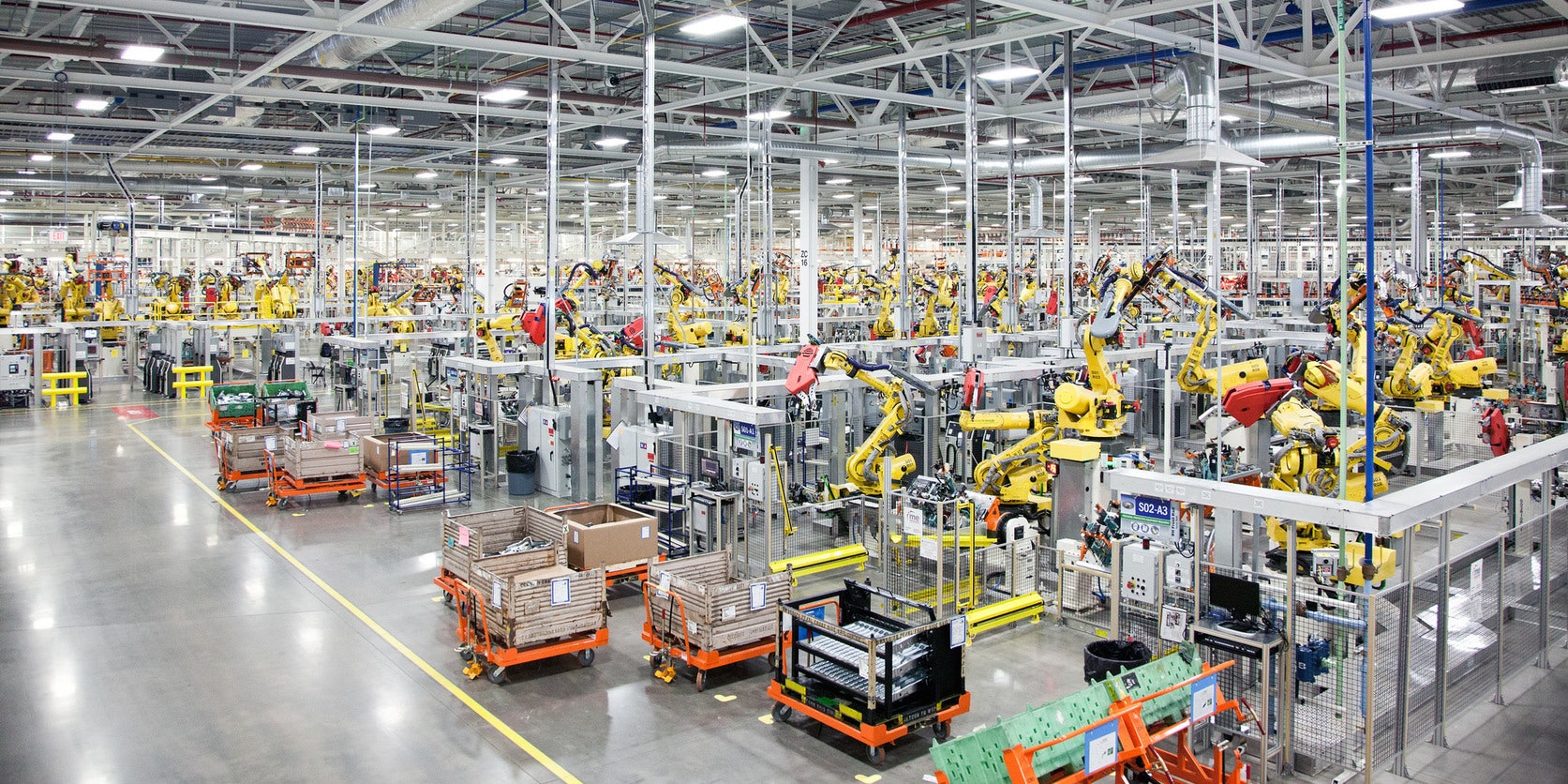
      image from Foxconn manufacturing site

      China’s economic miracle is directly attributable to its manufacturing industry. Approximately 100 million people are employed in manufacturing in China (in the U.S., the number is around 12 million), and the sector accounts for almost 36 percent of China’s Gross Domestic Product(GDP).

      Despite the huge challenges, a large number of manufacturers in China are planning to transform their production processes using robotics and automation at an unprecedented scale.
      Do they really have a choice? Human labor in China is no longer as cheap as it once was, especially compared with labor in rival manufacturing hubs that are quickly growing in Asia. In Vietnam, Thailand, and Indonesia, factory wages can be less than a third of what they are in the urban centers of China.
      So the solution for China, many manufacturers -and government officials- believe, is to replace human workers with machines.

      Almost a quarter of the world’s products are made in China today. If China can use robots and other advanced technologies to retool productions that never before automated, that might turn the country, now the world’s sweatshop, into a hub of high-tech innovation.

      But how this would affect the millions of Chinese factories workers?

      But this change will challenge U.S., European and Japanese industrial companies not used to competing with Chinese firms in the high-end segments of their markets.
      In other words, China may soon be known less for cheap Christmas toys and more for high-end medical equipment, luxury cars and jet engines.

      Saturday, April 22, 2017

      Growth has moved elsewhere...Where will you invest then?

      By 2025, China will be home to more large companies than either the United States or Europe. It is expected that nearly 50% of the world’s large companies—defined as those with revenue of $1 billion or more—to be headquartered in emerging markets.
      Image from Hubble telescope
      New emerging cities
      Nearly 50% of global GDP growth between 2010 and 2025 will come from 440 cities in emerging markets. 95% of them small and medium-size cities that many may not even have heard of and couldn’t point to on a map;


      Who has heard of Hsinchu, in northern Taiwan?
      Brazil’s Santa Catarina state, halfway between São Paulo and the Uruguayan border?
      Or Tianjin, a city that lies around 120 kilometers southeast of Beijing?
      In 2010, it is estimated that the GDP of Tianjin was around $130 billion, making it around the same size as Stockholm, the capital of Sweden. By 2025, it is estimated that the GDP of Tianjin will be around $625 billion—approximately that of all of Sweden.
      Lagos, economic capital of Nigeria, is predicted to be one of the 10 most populous cities globally. Nigeria's population is set to rocket to 397 million by 2050.

      Countries are becoming more urbanized
      By 2025, emerging economies will grow 75% faster than developed nations and will account for more than 50% of the world's economy. 440 cities in emerging markets will account for more than 50% global GDP growth and more than 50% of urban population (2.5 billion people) will live in Asian cities. 46 of the top 200 cities in the world will be in China.

      And this is going to happen in 6 years from now!
      The gravity center of the world will change its coordinates by then.

      Source: McKinsey & Company report on new disruptive forces